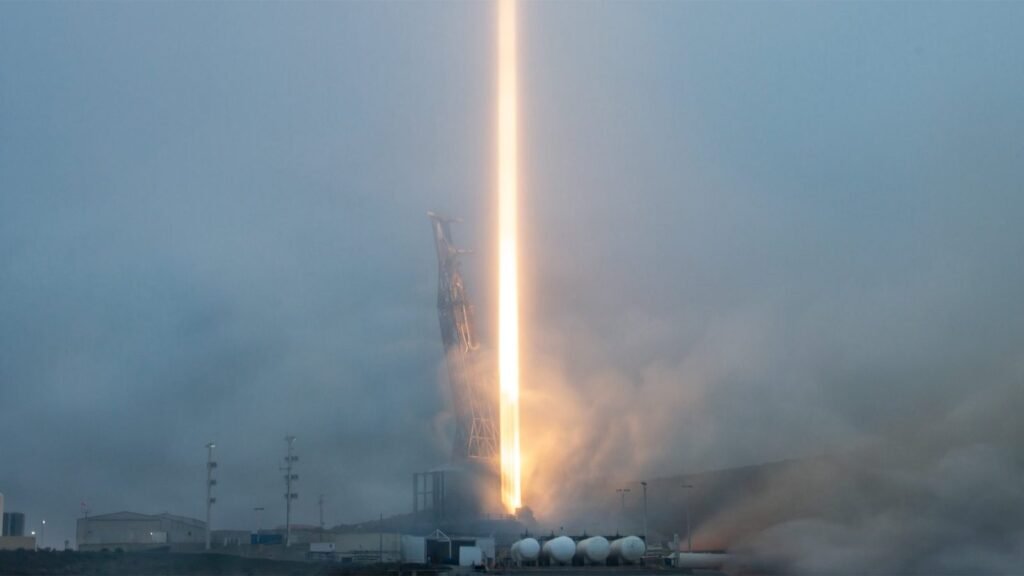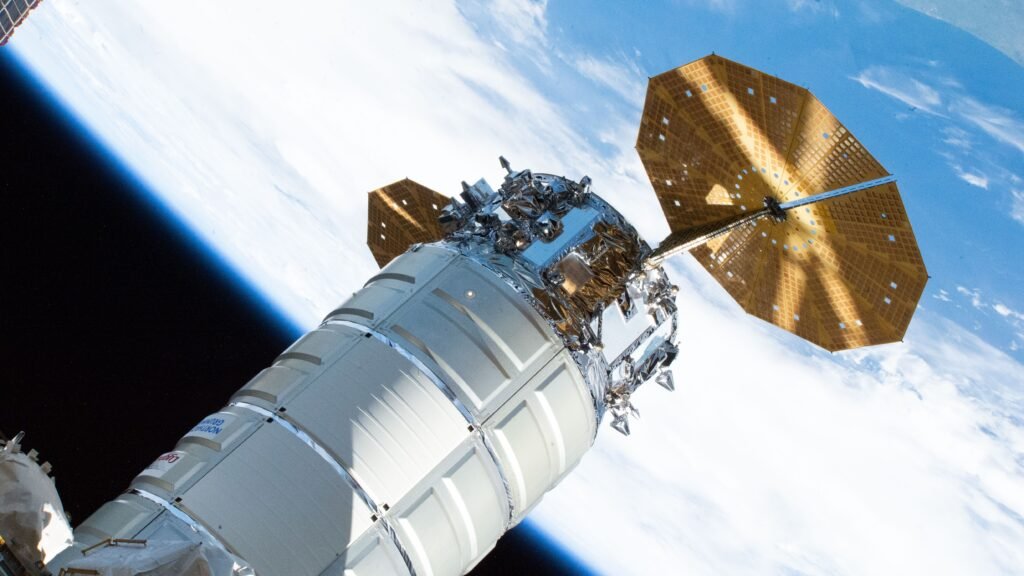
The next cargo ship bound for the International Space Station carries the name of the astronaut who once had to turn a lunar lander into a lifeboat. Northrop Grumman’s Cygnus XL spacecraft — the S.S. James “Jim” Lovell — is set to lift off on a SpaceX Falcon 9 no earlier than 10:47 a.m. EST on Sunday, 29 November, carrying about 11,000 pounds of science, supplies and hardware to the orbiting laboratory.
According to NASA, the spacecraft will reach the station two days later, when astronauts Jessica Watkins and Luke Delaney will use the Canadarm2 robotic arm to capture it at 2:35 a.m. EST on Tuesday, 1 December, and berth it to the Unity module. It will stay attached until May 2027, then depart loaded with rubbish and burn up harmlessly on re-entry.
The Freighter Named for a Lifeboat Commander
Lovell flew four missions — Gemini VII, Gemini XII, Apollo 8 and Apollo 13 — and on Apollo 13 his crew survived by using the lunar module as a lifeboat after an oxygen tank exploded on the way to the Moon. Northrop Grumman names each Cygnus for a pioneer of human spaceflight, and Lovell’s name ties a routine resupply run to the most famous improvisation in spaceflight history.
This is the third flight of the enlarged Cygnus XL, which carries 19.5 percent more cargo — 5,000 kilograms in a pressurised module nearly eight metres long. It is the 25th Cygnus built under NASA’s resupply contract, and the fleet has delivered more than 169,000 pounds to the station since 2013.
More Than a Delivery Run
The cargo hold is where this mission earns its keep. NASA says the experiments aboard include equipment for making tiny particles modelled on DNA, which could improve drug delivery for cancer and osteoarthritis; a study that aims to forecast whether a patient’s cancer will spread; and a follow-up to a muscle-loss experiment first flown during Expedition 65, testing therapies for wasting caused by spaceflight — and by ageing on the ground. A radiation detector and food-production research are also aboard, among more than 35 ISS National Lab payloads.
Then there is the job it may be asked to do once the boxes are unpacked. Spaceflight Now reports that Northrop Grumman’s Dave Schiller told Monday’s prelaunch briefing that, if NASA requests it, this Cygnus may perform one or more reboosts of the station — firing its engines to lift the station’s orbit, the delivery truck doubling as a tug.
Flying on a Rival’s Rocket
There is a second story in the launch manifest. NG-25 is the fifth Cygnus to fly on a Falcon 9 since Northrop Grumman retired its Antares 230+, and on Monday the company confirmed it has booked a sixth. NASASpaceflight reports Schiller telling reporters: “We do have one additional Falcon 9 on the manifest for Cygnus.” His own replacement rocket, the Antares 330, has no readiness date — Schiller would only say the company will share details “as they become available”.
NG-22, whose pressurised cargo module was damaged in transit in March 2025, is still being repaired, with no timeline for flight. NG-25’s booster, B1096, is making its ninth flight and will return to Landing Zone 40 — a routine recovery that underlines how completely this mission depends on its rival’s hardware.
Why This Matters
Here is what the launch-day coverage will mostly miss: the station’s supply chain now runs on SpaceX twice over — Dragon capsules and Cygnus freighters riding Falcon 9s — while altitude-keeping increasingly falls to visiting cargo ships. As NASA plans the station’s final years and its eventual deorbit, the humble freighter is quietly becoming orbital infrastructure rather than just a van.
The cargo points the same way. Cancer drug delivery, muscle-loss therapies and radiation sensing pay off on Earth, not only in orbit — and a mission named for the commander who improvised Apollo 13 home is, fittingly, carrying science that may one day do the same for patients who never leave the ground.
Meanwhile in Space: SpaceX’s CRS-35 mission delivered the final set of roll-out solar arrays to the station — and Crew-13’s record-breaking docking with the ISS.