Microsoft’s $2,599 MacBook Pro killer is here — asterisks included
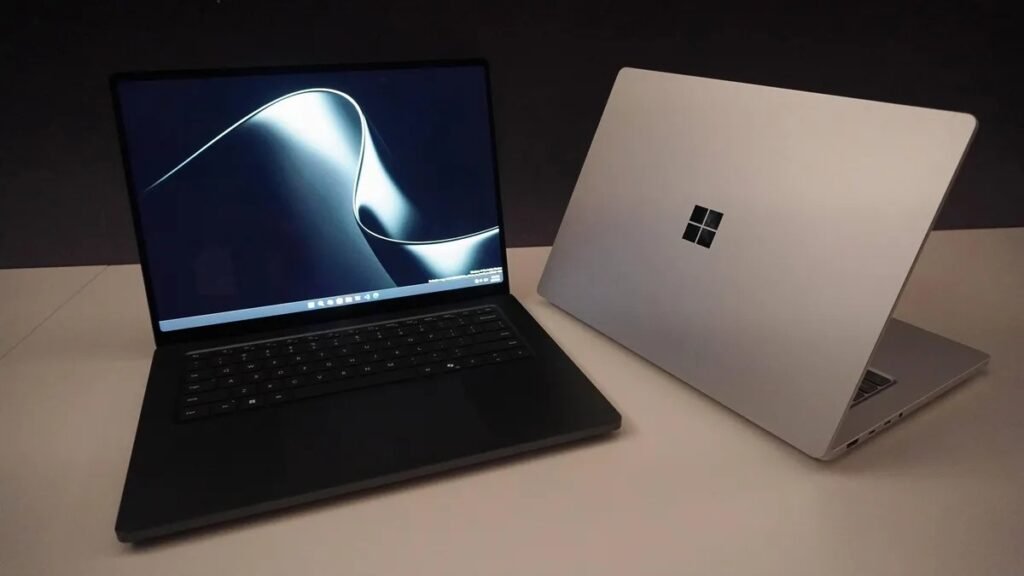
Microsoft and NVIDIA want you to believe the PC has been reinvented. At a San Francisco event on October 7, CEO Satya Nadella and NVIDIA chief Jensen Huang unveiled pricing and ship dates for the Surface Laptop Ultra, the RTX Spark-powered flagship Microsoft calls its most powerful notebook ever, Barron’s reports. It starts at $2,599 and ships October 16.
The spec sheet is genuinely startling: a 20-core NVIDIA Grace CPU, a Blackwell RTX GPU with up to 6,144 cores, up to 128GB of unified memory, and enough local AI muscle to run 120-billion-parameter models without touching the cloud. Microsoft says it beats Apple’s M5 Pro MacBook Pro by up to 6.2x, MarketWatch reports. But nearly every one of those numbers comes with an asterisk — and the asterisks are the real story.
What “6.2x faster than a MacBook Pro” actually measures
Microsoft’s claim is precise in a way the headline is not: up to 6.2x faster video generation and 4.3x faster image generation than Apple’s M5 Pro MacBook Pro, per MarketWatch. These are AI-workload victories — token speed, image generation, video generation — not general computing. Your browser tabs and spreadsheets will not run six times faster.
The pricing comparison Microsoft clearly wanted you to make is real, though. The 16-inch MacBook Pro starts at $2,999, so the Ultra’s $2,599 entry price undercuts Apple by $400 for buyers targeting the same creator-and-developer market, MacRumors notes.
The fine print behind “1 petaflop” and “2,000 nits”
The headline “up to 1 petaflop” of AI compute is a theoretical figure: FP4 precision with sparsity, as a footnote-by-footnote breakdown by TechMyMoney points out — and TechRepublic cautions it should not be taken as a measure of performance across all workloads. The same footnotes reveal the CPU and GPU share the 128GB pool, meaning the GPU can address less than the total.
The display story rhymes. Microsoft’s “brightest, sharpest, and most vivid” Surface display hits 2,000 nits of peak HDR brightness — but measured over a 10% window with HDR content, with sustained and standard-dynamic-range brightness lower, per TechMyMoney’s reading of the footnotes. The 25%-brighter-than-M5-MacBook-Pro claim compares published specs as of October 1.
The $2,599 price has an asterisk too
That starting price buys the 18-core RTX Spark variant with 24GB of unified memory and 512GB of storage. The full machine, with the 20-core chip, 128GB of memory, and 1TB SSD, runs $5,899.99, according to Notebookcheck’s pricing rundown. The $2,599 model is the on-ramp, not the showcase.
Microsoft also opened preorders for the $5,999 Surface RTX Spark Dev Box — a desk-bound version of the same silicon for developers running open-weight models like DeepSeek locally — and teased a DGX Station for Windows that can run trillion-parameter models later this year, Thurrott reports. Six PC makers — ASUS, Dell, HP, Lenovo, MSI, plus Microsoft — are now shipping RTX Spark machines at once.
Why this matters: the “hybrid intelligence” PC is real — the marketing isn’t the product
Cut through the footnotes and the shift is genuine: this is the first Windows laptop line built around running frontier-class AI models entirely on-device — no API calls, no per-token bill, no data leaving the machine. Nadella’s pitch was “hybrid intelligence”: a future where you never think about whether something runs locally or in the cloud, Barron’s reports. For developers and creators who currently rent GPU time to run big models, a $2,599 laptop that replaces that bill changes the economics of their work.
But Microsoft is selling a benchmark, not a computer. The honest version of this launch: a $2,599-and-up Arm Windows laptop with genuinely best-in-class local AI throughput, a claim of 99% of performance on battery, a magnetic USB-C charger, upgradeable storage, and a full port selection — that beats Apple at AI chores while asking you to trust vendor benchmarks and run x86 apps through Prism emulation, MacRumors notes. That is exciting enough without the 6.2x.
Meanwhile in Apps & Tools: the on-device AI assistant that asks for no subscription — the software side of the local-AI wave.
Meanwhile in Gadgets: Apple and LG are loading up the smart home while Microsoft reloads the PC — October is hardware month.