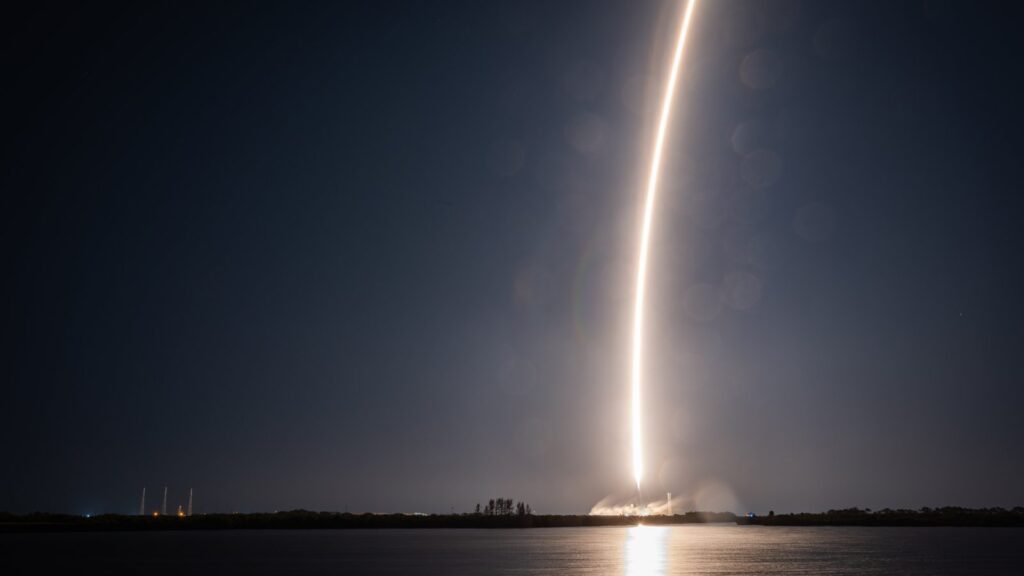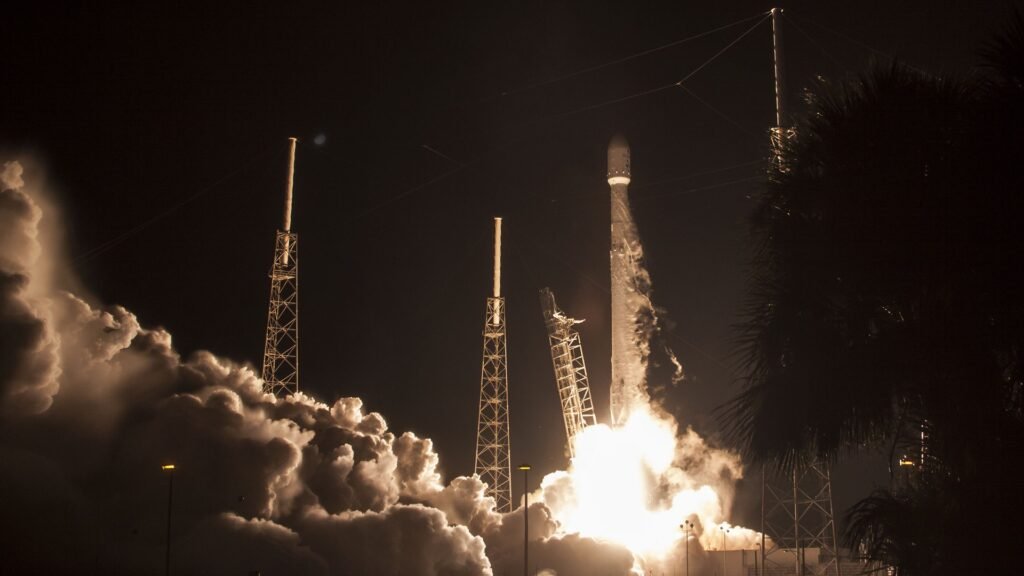
Google’s first AI hardware in space is now in orbit — and it got there on a rival’s rocket. On October 1, the Project Suncatcher prototype satellite reached orbit aboard SpaceX’s Transporter-18 rideshare on a Falcon 9 from Vandenberg Space Force Base in California. Google confirms the team has made contact with the spacecraft and that it is “operating as expected.”
Built with Planet Labs, the refrigerator-sized prototype carries four Google Trillium-generation TPUs — the same class of chips powering its Earth data centers — for the first-ever test of Google AI hardware in space. The Transporter-18 flight carried 20 satellites total, including the Suncatcher demo, Planet’s hyperspectral Tanager-2, and 18 SuperDoves, per Planet’s release.
Not a data center — a survival test
Here is what the commodity rewrites get wrong: this is not Google’s “AI data center in space.” Google is explicit that Suncatcher is a long-term research moonshot answering three questions — can the chips survive launch vibration, can they survive radiation, and can their heat be shed in vacuum.
The engineering numbers are extreme. The TPUs endured launch acceleration up to 10g sustained (and 50–100g on individual chips), survived radiation doses beyond a five-year mission at UC Davis’s Crocker Nuclear Laboratory, and now face the hardest problem: cooling. With no air in space, heat can only escape through radiators — so the chips run in roughly 15-minute bursts before shutting down to cool. Google is also publishing the underlying research in a peer-reviewed paper in the journal *Joule*.
Why space, why now
The motive is terrestrial. Google’s research says orbital solar panels can generate up to eight times more power than panels on the ground — while Earth’s data centers fight for grid capacity, the sun in orbit is free and nearly constant. The prototype flies a dawn-dusk sun-synchronous orbit to stay in near-permanent sunlight, on about a kilowatt of solar power.
But Google’s own math is honest about the gap: orbital compute only pencils out if launch costs fall to roughly $200 per kilogram — about seven times cheaper than current Falcon Heavy pricing. The roadmap from here: gather in-orbit data over the coming months, fly two satellites in 2027 to test high-bandwidth optical laser interconnects, and eventually design clusters of up to 81 satellites.
The delicious irony
The experiment rides a SpaceX Falcon 9 — and SpaceX is reportedly developing its own orbital-compute answer, a constellation called Starmind that could dwarf anything Google is testing. So for now, Google’s future space infrastructure is entirely dependent on the rockets of the company most likely to compete with it there.
It is also a small reunion story for TechXova readers: the very same Falcon 9 carried India’s TakeMe2Space MOI-1A orbital-computing satellite, which we covered at launch yesterday — two competing visions of orbital AI, Google’s experiment and a startup’s paying storefront, riding one rocket.
Why this matters
Suncatcher matters less as hardware than as a forcing function. Google is putting its own physics research in public: the 15-minute bursts, the $200/kg threshold, the Joule paper. That is how you find out whether orbital AI is a real industry or a fever dream — and the timeline is concrete enough to grade: in-orbit data this year, laser-linked satellites in 2027, clusters after that.
The bet is simple to state. Earth’s grid is the bottleneck for AI scaling; the sun is not. If launch costs keep falling and the chips keep cooling, the data center of 2035 might not be in the ground at all.
Meanwhile in Space: India’s MOI-1A orbital-compute satellite launched aboard the very same Falcon 9.
Meanwhile in AI Tech: Google’s Gemini 4 Argon is winning benchmarks while its own engineers stay skeptical.