Boston Dynamics has redesigned the business end of its Atlas humanoid, and the headline feature is what it left out. On October 1, the company unveiled a completely new hand for Atlas — four fingers, 13 degrees of freedom, nearly double the previous hand’s 7 — and made the case that the fifth finger was never worth having in the first place.
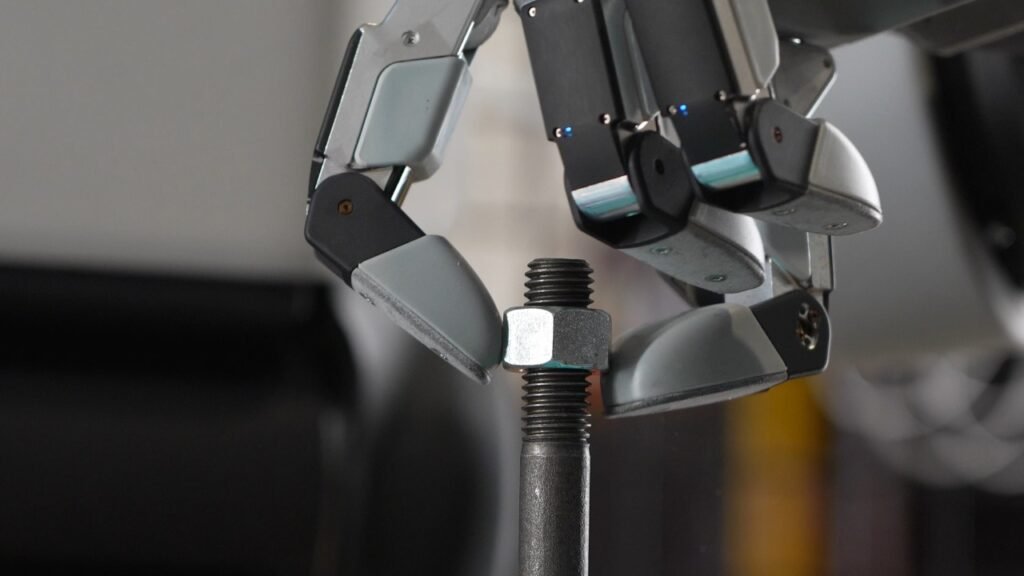
The demo reel is legitimately impressive. Atlas picks up a slender drill bit with its fingertips, inserts it into a power drill, presses the trigger, and drills into wood. It pinches and tightens a small nut, spins a drumstick between its fingers, and rolls two golf balls inside one hand. This is not waving at the camera — it is tool work.
The pinky experiment
The engineering story behind the missing pinky is the part no competitor rewrite has touched. Boston Dynamics CTO Zack had the design team tape their pinky and ring fingers together for a day to see what four fingers could really do. The verdict: a fifth finger added three more actuators’ worth of cost, volume, and failure points without meaningful capability gains. In the company’s words: the best part is no part.
Engineer Alberto Rodriguez, who led the design, calls hands “a ruthless design trade-off.” The hand keeps a four-DOF thumb plus three three-DOF fingers that can splay — motions Rodriguez says go “beyond what human hands are capable of” — with a single actuator type, fully encapsulated actuators, no fragile cables or tendons crossing joints, and dense pressure-sensing across fingertips and palm. It is roughly the size of a large human hand and can carry a loaded 100-pound-plus minifridge, Boston Dynamics says.
Rejecting human mimicry on purpose
This is where the design philosophy gets interesting. Rivals like Clone Robotics, 1X, Figure, and Unitree are racing toward eerily humanlike hands. As IEEE Spectrum reports, Rodriguez dismisses those as “research and demos” — beautiful, fragile, and unmanufacturable. Boston Dynamics is explicitly choosing manufacturability over anatomy: the hand is designed for a 100,000-hands-per-year production target, with a backdrivable transmission for force feedback and sim2real reinforcement-learning training built into the design from the start.
The grasp set is unapologetically industrial: pinch grasps thumb-to-any-finger, tripodal grasps, and triggered tool grasps — drills, power torque drivers, grinders, nail guns, welding torches. The hand is built to work, not to wave.
The factory timeline
The hand is the hardware centerpiece of Atlas’s push into real factory work. Boston Dynamics just opened the RMAC (Robotics Metaplant Application Center) training center inside Hyundai’s Metaplant America in Georgia on September 30. Per the Seoul Economic Daily, parts-sequencing deployment starts in 2028, expanding to parts assembly by 2030, with a long-term target of 25,000 Atlas units across Hyundai and Kia plants worldwide.
Why this matters
The humanoid race has a fixation problem: everyone keeps score on how human the robot looks. Boston Dynamics is now publicly arguing that is the wrong metric — that the winning hand is the one you can build a hundred thousand of, service in a factory, and train with real physics feedback, not the one that fools a photograph.
It is also a bet that manipulation, not locomotion, is the industry’s real bottleneck. Legs got Atlas through the door; the hand decides whether it earns a job. If the four-finger design holds up through the Georgia training years and scales to the 2028 sequencing line, the pinky will be remembered as the feature that got value-engineered out of robotics’ most important decade.
Meanwhile in Robotics: Destro AI just raised $8M to coordinate robots and humans as one crew.
Meanwhile in Cars & EVs: Ford’s $30K Fathom launch faces the same factory-scale math.