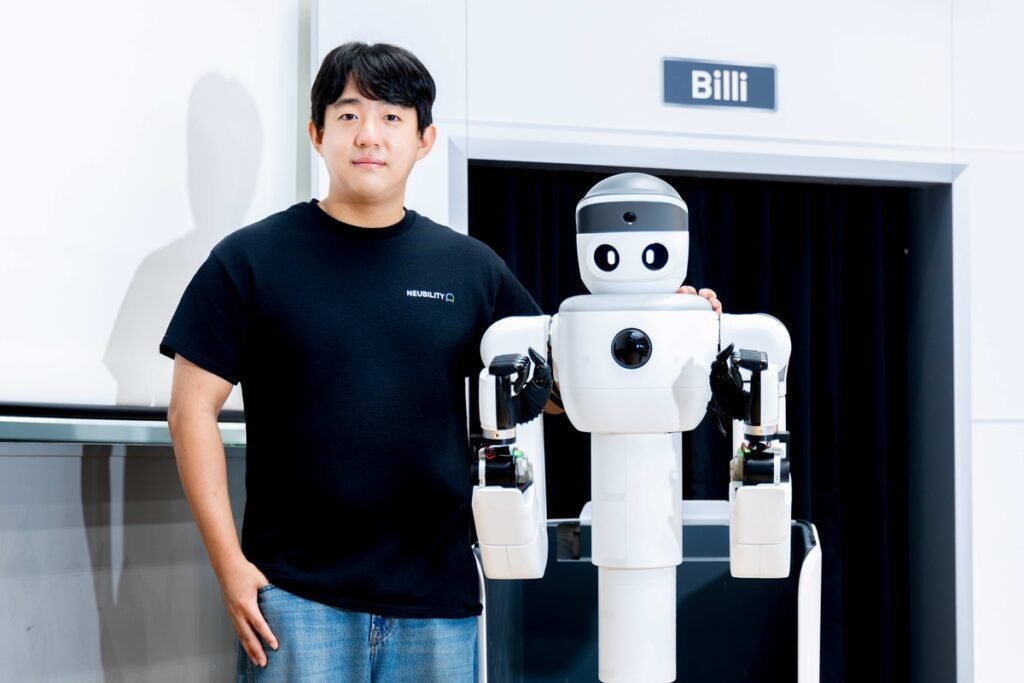
While the rest of the humanoid industry chases the perfect walking demo, a Korean startup just shipped the opposite bet. Neubility unveiled “Billy” on September 29 in Seoul — a semi-humanoid robot with a human-like upper body bolted onto a four-wheel drive base. No legs. No backflips. Just a machine designed to get to work. Seoul Economic Daily reported the unveiling.
The company’s framing is blunt: “our goal is the fastest path to commercialization.” Billy is gunning for the title of fastest-commercialized humanoid in South Korea.
What Billy Actually Is
Billy stands up to 1,497mm tall with 16 degrees of freedom — a fraction of what a full bipedal humanoid carries. It has five-fingered robotic hands, and its upper body rotates a full 360 degrees. Rather than replicating every human motion, Neubility concentrated on autonomous movement and simple tasks, powered by a robotics AI model that recognizes on-site equipment and object placement to make task decisions.
The design logic is hard to argue with. Legs are the hardest problem in humanoid robotics — balance, terrain, fall recovery, energy cost. Wheels solve locomotion on flat factory floors today, at a fraction of the complexity. Every engineering hour not spent keeping the robot upright is an hour spent on the hands and the task AI, which is where the actual economic value lives.
Proof-of-concept testing is already lined up at four companies, including food giant CJ CheilJedang. Neubility says it aims to deploy several hundred units within one to two years.
The Anti-Hype Playbook
Billy arrives in a market drowning in hype. The International Federation of Robotics counted roughly 7,000 humanoid robots sold worldwide last year — most bought by research labs or companies generating training data, not doing productive work. Carmakers, the key early adopters, are running pilots with “single-digit or sometimes double-digit numbers of robots,” per the IFR’s secretary general. Billions in investment, impressive demos, and a commercial reality that is still mostly PowerPoint.
Neubility’s answer is to stop competing on the demo and start competing on deployment. A wheeled semi-humanoid can’t go viral doing parkour — but it can navigate a warehouse aisle tomorrow without a team of engineers babysitting it. It’s the same logic that made autonomous mobile robots (AMRs) a real business while bipeds were still falling over on YouTube: solve the environment you have, not the one in the keynote.
Korea’s Bigger Bet
Billy isn’t a one-off. Korea’s T-Robotics was just selected to lead a government-backed project developing AI humanoids for display manufacturing, running through December 2030 with 4.5 billion won in government funding. Seoul is treating embodied AI as industrial policy — and the Korean approach, judging by both announcements, skews pragmatic: robots that work in real factories, not robots that win demo competitions.
Why This Matters
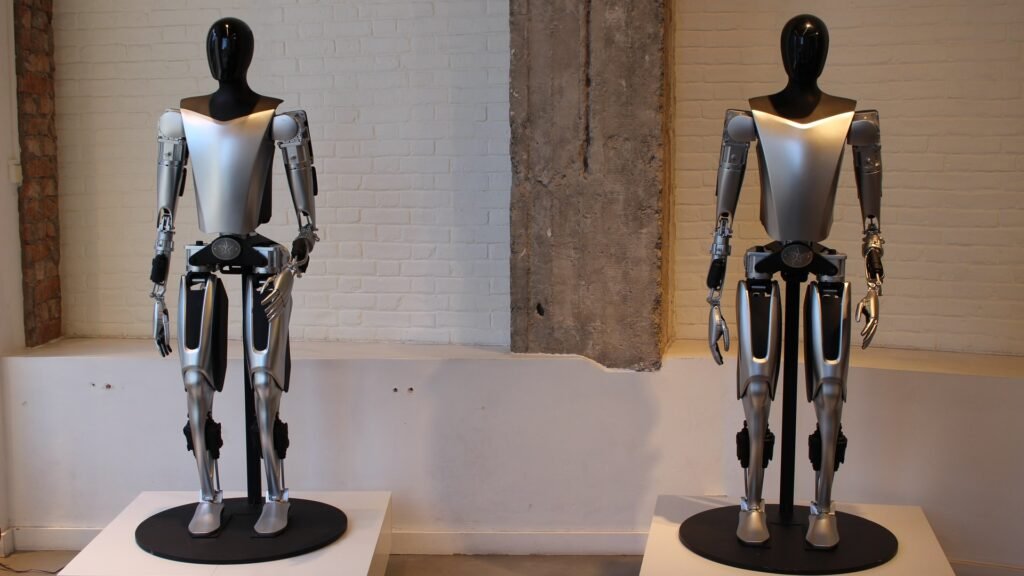
The humanoid race has a quiet split forming. One camp — Tesla’s Optimus, Figure, the Chinese labs — is betting that full bipedal humanoids will generalize across every human environment. The other camp, now led by machines like Billy, is asking a heretical question: what if legs are a vanity feature? For the flat, structured floors where robots actually earn money, wheels plus good hands plus task AI might get to revenue years earlier. Billy won’t win any robot Olympics. It might win the part that matters: purchase orders.
Meanwhile in Robotics: