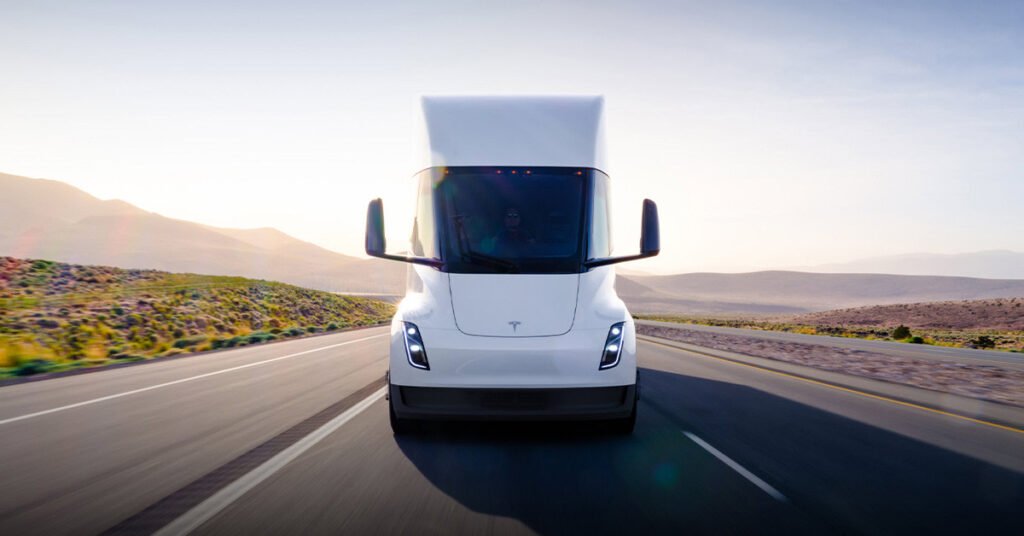
Tesla has started handing its Semi electric truck to customers from its new Nevada factory, declaring the start of “high-volume production” — without disclosing how many trucks it’s actually producing, what they cost, or how many orders it has in hand.
The delivery event, held September 24 at the company’s Sparks, Nevada plant, marked the highest-profile milestone yet for a program that has stretched nearly a decade. Reuters reports that Tesla billed the September 24 event as the formal rollout of volume production, nine years after Elon Musk first unveiled the truck.
A nine-year road to “high-volume”
The timeline is familiar to anyone who has watched this truck. Musk unveiled the Semi in 2017 with production targeted for 2019. That slipped — repeatedly. A handful of trucks reached PepsiCo in a limited 2022 handover. On April 30 this year, the first Semi rolled off the plant’s high-volume production line, Reuters reported. Then, in July, Tesla’s shareholder letter quietly dropped its volume-production forecast, casting doubt on the ramp.
The September 24 event was supposed to settle that. Instead, it reopened the oldest question in the Semi story: how many?
A 2,500-truck order in a market still in its infancy
The demand signal Tesla does have is real. A coalition called ZET SCALE — backed by Microsoft and PepsiCo — has ordered 2,500 Semis, a commitment that, per Catalyst Mobility, is nearly double the existing U.S. fleet of electric Class 8 trucks. That single order would almost triple the number of electric big rigs on American roads.
It’s both an endorsement and a measure of how small this market still is.
What Tesla shared about the truck — but not the factory
According to Reuters, Semi program chief Dan Priestley told the event the truck delivers “500 real-world miles… validated by customers,” and the company confirmed 325- and 500-mile variants rolling out of a 1.8-million-square-foot plant in Sparks. U.S. fleet customers took the stage: PepsiCo, DHL and US Foods. Musk, appearing on video, claimed “the waiting list is already pretty significant.”
What he didn’t say: how many trucks are rolling off the line today, what one costs, or how big that waiting list is. The only capacity figure on the table remains the long-standing 50,000-trucks-a-year target — a plan, not a production number.
A diesel-price tailwind behind Tesla’s timing
The market context keeps improving. A September 27 Reuters report found that an Iran-linked diesel price spike has made electric trucks cheaper to own than diesel rigs in key European markets, with fleet savings adding up across the Netherlands, Germany and Denmark. Every jump in diesel prices strengthens the total-cost-of-ownership case that electric trucking has to win on.
Tesla’s timing, in other words, isn’t luck. Fleets are watching fuel economics, not launch events.
Why this matters
This is the story behind the press release: Tesla is asking the industry to celebrate a production milestone it refuses to quantify. Nine years in, there is still no price, no current production rate, and no order book — just a planned-capacity number and a CEO’s word that demand is “significant.” For fleet buyers who sign multi-year equipment contracts, those missing numbers matter more than the ceremony.
The skepticism cuts both ways. If Tesla is truly ramping at Sparks, the 2,500-truck ZET SCALE order shows demand is waiting. But until Tesla says how many Semis it’s actually building — or what it’s selling them for — “high-volume production” is a claim, not a fact. The numbers Tesla didn’t share are the real story.
Meanwhile in Cars & EVs:
- Bentley Torcal debuts as the brand’s first-ever EV — 876 HP, 375-mile range, $230,000 sticker
- Rivian recalls 99,000 R2, R1S and R1T EVs over rearview camera glitch — OTA fix already out