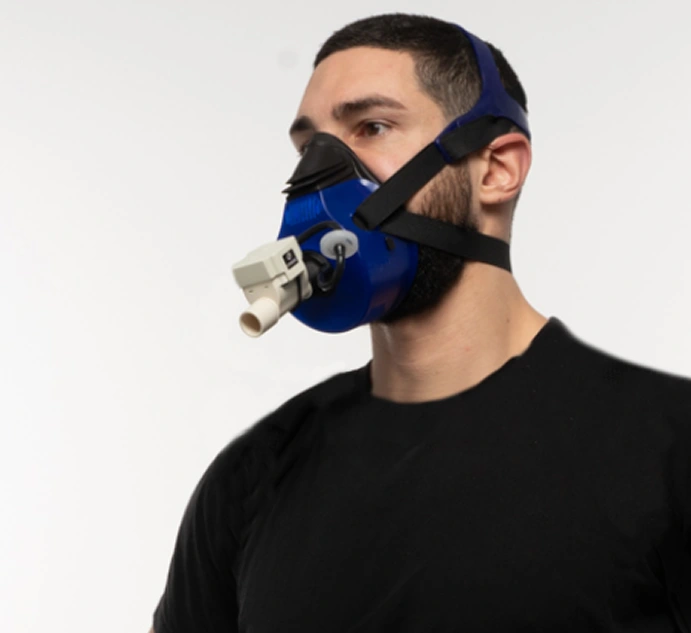
Your next gym visit might come with a mask — not for your workout, but for an eight-minute breath test. PNOĒ, a Malden, Massachusetts startup, launches the PNOĒ 2.0 on October 1: a self-serve mask measuring VO₂ max and 22 other metabolic biomarkers with no trained operator. TechCrunch reports the big change is self-administration — walk into a gym, strap on the mask, press a button, and breathe.
Two things to know first. One: this is not a medical device. PNOĒ is explicit that the 2.0 is not FDA-cleared and gives no medical recommendations — think smart scale, not blood panel. Two: you can’t buy one. PNOĒ sells only to businesses — gyms, spas, hotels — at $400–$1,000 a month. 85% of its business is American, with clients including Equinox, the NBA, Four Seasons, and Mount Sinai. This is a “coming to your gym” story, not “add to cart.”
Wellness data, not a diagnosis
Metabolic testing is a century-old science that long meant bulky gas analyzers in sports labs — the province of elite athletes and executive wellness programs. PNOĒ claims its compact device matches that lab-level accuracy, then converts breath data into eating and training guidance. But RuntimeWire flags a caveat: the peer-reviewed evidence covers healthy adults on treadmills, which doesn’t establish accuracy for unsupervised self-serve use. October is the real-world test of that gap.
VO₂ max, RMR, metabolic flexibility: decoded
The three headline numbers, in plain English:
VO₂ max — the maximum oxygen your body can use during hard exercise (ml/kg/min). Higher means a fitter heart, lungs, and muscles. It earns the “strongest predictor of longevity” label because cardiorespiratory fitness correlates with mortality more powerfully than most classic risk factors. Peter Attia has cited research linking a move from “low” to “below average” VO₂ max with roughly 50% lower all-cause mortality — “low” to “above average,” closer to 70%.
Resting metabolic rate (RMR) — the calories you burn doing nothing. It should determine how much you eat, and most people’s guesses are wrong.
Metabolic flexibility — how efficiently your body switches between burning fat and carbohydrates. Good flexibility means your engine adapts to available fuel; poor flexibility means energy crashes and stubborn weight.
The accuracy ladder: lab cart vs. mask vs. watch vs. Lumen
1. Lab metabolic cart — the gold standard. Directly measures oxygen inhaled and CO₂ exhaled during a max-effort test. Expensive, staff-run, and the benchmark everything else is judged against.
2. PNOĒ 2.0 — the claimant. Lab-level accuracy claimed in a portable, eight-minute, self-serve format, tracking 23 biomarkers from breath. It also solves gym hygiene: the electronics detach from the silicone mask and straps, so the gym reuses the core while each customer keeps a personal facepiece. Independent validation of the self-serve version is still pending.
3. Apple, Garmin, Whoop — the estimators. Your smartwatch never measures your breath. It estimates VO₂ max from heart rate, pace, age, and workout history. Fine for trends, but it’s a guess in a lab coat: one writer’s Apple Watch read mid-60s while the lab measured 52.4.
4. Lumen — the specialist. A handheld that measures CO₂ in one exhale to estimate whether you’re burning fat or carbs. Handy for nutrition timing, but it doesn’t measure VO₂ max at all.
The business behind the mask
PNOĒ is a 110-person company that recently turned profitable, has raised about $22 million, and plans a Series B in 6 to 12 months. The 2.0 was designed with Milan-based Design Group Italia through what CEO Apostolos Atsalakis told TechCrunch was “a lot, a lot, a lot of iterations.” Without the operator, it works in unstaffed gyms, boutique studios, and potentially pharmacies.
Why this matters
The question nobody’s asking decides everything: can ordinary gym-goers strap this on and breathe consistently enough, with no technician correcting the fit, to produce data worth acting on? PNOĒ’s entire bet rests on yes. If it holds, lab-grade metabolic data stops being an elite-athlete perk and becomes a gym-floor amenity, sold as a service by the place you already pay dues to. If it doesn’t, it’s a very expensive Bane mask. Watch the October 1 rollout from the gym floor, not the checkout page.
Meanwhile in Gadgets: Meta’s gesture-control wristband turns muscle signals into device commands — another bet that the next interface is your body, not your screen.