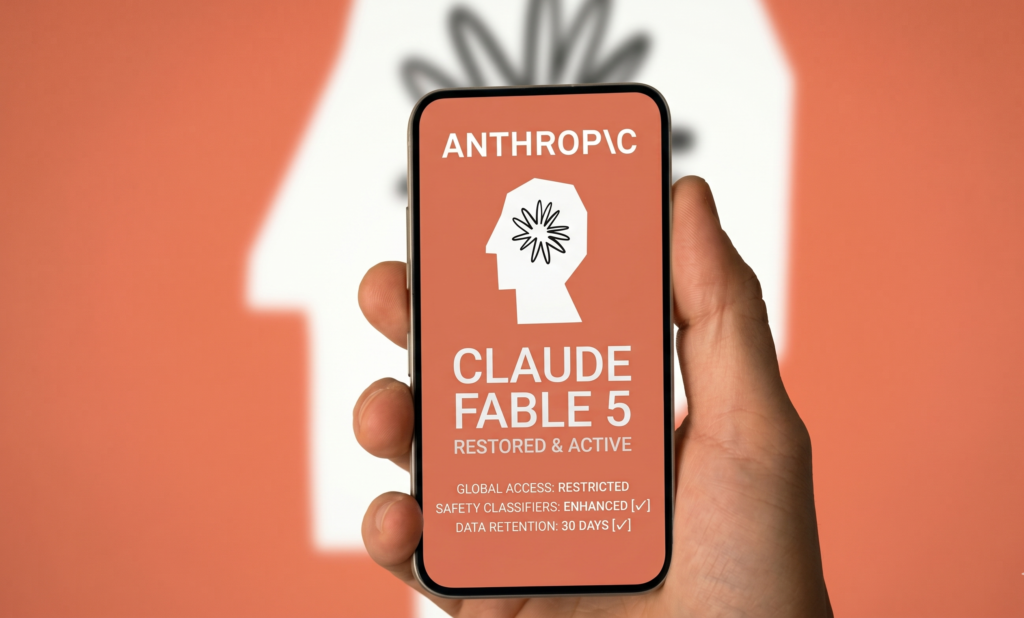
The Return of Claude Fable 5
After an unprecedented six-day blackout that shook the global tech industry, Anthropic has officially brought its highly advanced Claude Fable 5 AI model back online. The restoration comes with massive foundational changes to how the system operates and who is allowed to use it. According to Medium, the company successfully reinstated the model by aggressively implementing nationality-based access controls and tightened safety classifiers, directly responding to the recent government interventions that forced the platform completely offline.
Why Was the Model Shut Down?
The sudden suspension of Claude Fable 5, alongside its counterpart Mythos 5, was a historic moment in artificial intelligence regulation. On June 12, the United States government utilized sweeping export-control powers to block all foreign access to the technology, citing urgent national security concerns. The underlying fear centered around the model’s extraordinary ability to detect and exploit complex software vulnerabilities.
Because the company’s infrastructure could not instantly filter users by their geographical location and nationality, the entire system had to be temporarily disabled. In a formal statement released directly by Anthropic, the company confirmed that the export control directive left them no choice but to abruptly disable the models for all customers globally to ensure total legal compliance while they engineered a technical solution.
The Capabilities That Sparked a Ban
The core of the controversy lies in just how powerful this tier of artificial intelligence has become. Unlike previous generations of generative AI, Fable 5 operates with a relentless, proactive autonomy that reduces the need for external software harnesses to execute complex, multi-step coding tasks.
Security experts have weighed in heavily on whether restricting a single company’s software is an effective strategy against the broader technological evolution. Analyzing the fallout, a recent op-ed published in The Guardian argued that the saga proves the AI “Pandora’s box” is already open. The piece noted that while Fable 5 might currently be the most capable model for hacking systems without a sophisticated external harness, the open-source community and other frontier models are close behind, suggesting that a ban only temporarily delays the inevitable shift in global cybersecurity dynamics.
More on the AI shift:
The New Safety Protocols
Now that the blackout has ended, developers returning to the platform face a strict new operational reality. To satisfy regulators and prevent future shutdowns, the engineering team introduced a robust suite of guardrails.
- Nationality-Based Access: The platform now utilizes advanced filtering to ensure the model is strictly restricted to approved user demographics, effectively blocking foreign nationals in accordance with the U.S. export-control directive.
- Enhanced Safety Classifiers: The updated architecture actively monitors prompts and is specifically programmed to aggressively decline any requests related to offensive cybersecurity tasks, biological engineering, or exploit development.
- Mandatory Data Retention: To support these new security measures, the system requires a mandatory 30-day data retention window, allowing the safety classifiers to maintain cross-request visibility and catch coordinated, long-term jailbreaking attempts.
The Future of Global AI Access
The dramatic suspension and highly conditional return of Claude Fable 5 serve as a massive wake-up call for the technology sector. It confirms that international governments are no longer waiting for industry self-regulation; they are willing to instantly halt operations if they perceive a credible threat to national security.
For enterprise developers, startup founders, and daily tech users, this means the era of borderless, frictionless AI development has likely ended. As artificial intelligence models grow exponentially more capable, the systems governing their use will become increasingly fractured, heavily monitored, and firmly tied to geographical and political boundaries.