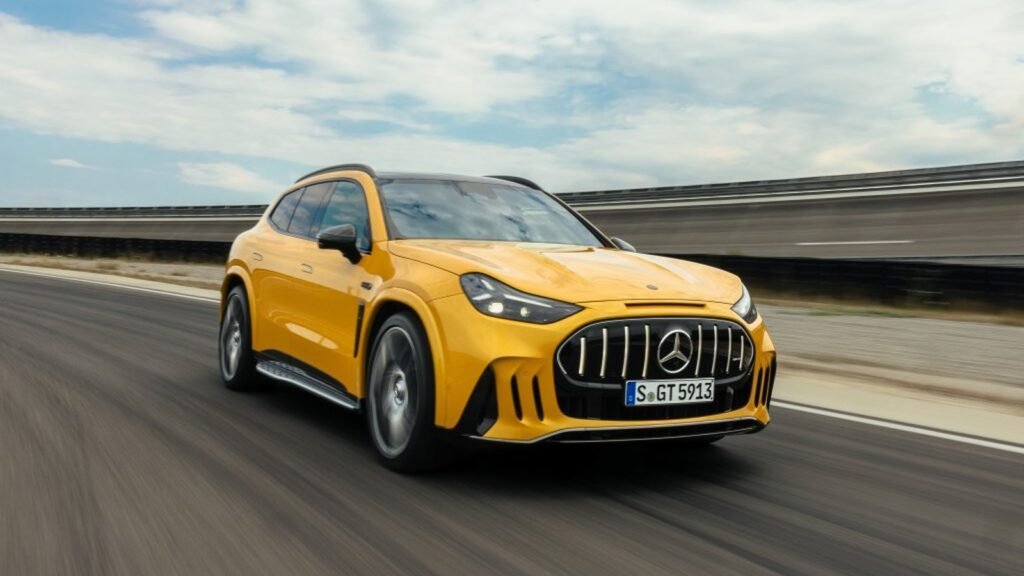
Mercedes-AMG finally pulled the cover off its worst-kept secret on October 17, revealing the 2028 AMG GT SUV at Stuttgart’s 140 Festival — the first full-size SUV the performance division has developed entirely in-house in its 59-year history. According to Electrek, the electric flagship reaches US dealerships in summer 2027 with three variants and a spec sheet aimed squarely at the Porsche Cayenne Turbo Electric.
The range-topping GT 63 makes 1,153 horsepower and 1,475 lb-ft of torque from three axial-flux motors, hits 60 mph in a claimed 2.4 seconds with rollout, and charges at up to 710 kW — enough, Mercedes says, for 10 to 80 percent in 12 minutes. The GT 55 makes 805 hp; the entry GT 53 makes 536 hp from two conventional motors and charges at 600 kW.
1,153 Horsepower — for 63 Seconds
Here is the part the headlines skip: the 1,153-hp figure is a temporary boost, not the car’s working output. TFLcar reports the GT 63 can only hold full power for 63 seconds before output steps down — to 711 hp, the continuous rating Mercedes itself publishes for both the GT 63 and the GT 55. The GT 55’s boost lasts 55 seconds; the GT 53’s, 53.
That is not a defect — it is how every high-output EV works. But 711 hp is the number that defines the car in real driving; the peak figure is the marketing one.
The 710 kW Charger That Doesn’t Exist Yet
The charging claim carries the same asterisk. A 128 kWh usable pack charging at 710 kW would be a genuine breakthrough: 12 minutes for 10 to 80 percent, or 83 kWh added in 10 minutes at an average of about 498 kW, InsideEVs notes. But there is nowhere in America to actually do it.
The fastest public chargers being deployed in the US, like the ones IONNA is rolling out, are rated around 400 kW. At that speed the big-battery GT SUV needs 16 minutes for the same 10-to-80 run — still fast, but nowhere near the headline. The fastest US charger in the pipeline, a 750 kW unit, has already slipped to next year. Mercedes lists NACS among the five charging standards the SUV supports, so Tesla Superchargers will work fine; they just will not come close to 710 kW. For perspective, China already has 2,250 kW chargers in service. As Electrek put it, American buyers will mostly be paying for headroom on future stations.
AMG’s Real Bet: Halo Over Volume
Step back and the strategy snaps into focus. Mercedes just cut the EQE and the Maybach EQS SUV from its 2027 lineup, Electrek reports — the volume electric cars are gone, and in their place comes a halo: an AMG-developed flagship whose price Mercedes has not announced, but which TFLcar estimates could run from just north of $150,000 for the GT 53 to around $250,000 for the GT 63. For reference, the Cayenne Turbo Electric it is aimed at starts at $163,000.
The engineering underneath is serious: axial-flux motors from YASA, the British specialist Mercedes bought in 2021; cylindrical cells bathed in non-conductive oil; a silicon-anode chemistry Mercedes claims exceeds 298 Wh/kg at the cell level. And yes, a fake V8 soundtrack comes standard in Sport+ mode.
Why this matters
Read the GT SUV as a statement about where legacy luxury thinks the electric transition pays: not in $50,000 family EVs, but in quarter-million-dollar flagships where a 63-second burst of 1,153 hp and a charging spec no station can match are selling points precisely because they are excessive. The genuinely important number on this spec sheet is 128 kWh — a big, oil-cooled, 800-volt pack with real sustained output — because that hardware will eventually filter down to cars normal people buy. The rest is theater. Very good theater, but theater.
Meanwhile in Cars & EVs: nine-minute charging claims are the industry’s new arms race — BYD’s Atto 8 made its own bold charging promise at the Paris show, with a catch of its own — and Bentley just showed its first-ever EV, the Torcal, as the ultra-luxury brands pile into electric.