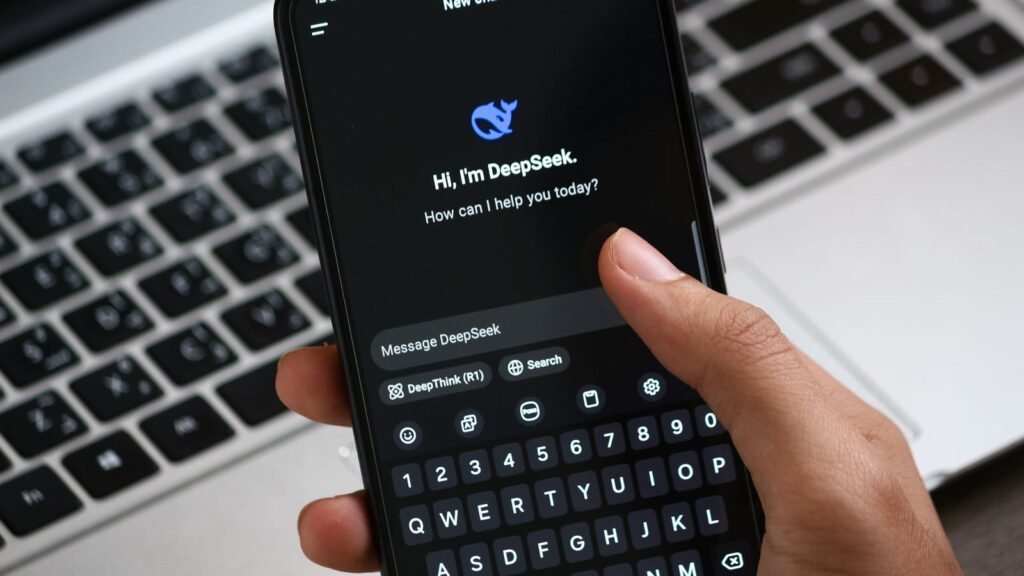
Two days after Washington ordered civilian agencies to rip DeepSeek out of their systems, the Chinese AI lab has reportedly answered with one of China’s largest-ever private funding rounds. TechCrunch reports, citing Bloomberg, that DeepSeek has raised about $15 billion, roughly 100 billion yuan, from a roster of backers that reads like a map of corporate China.
The timing is the story: on October 20, Homeland Security published a July 24 order directing civilian agencies to remove DeepSeek products, and third-party products built on them, and to stop buying them. Two days later, the money arrived anyway.
Banned on Monday, Bankrolled by Thursday
The order is narrower than headlines suggest, and broader in one way. It covers civilian agencies only, not the Pentagon, and does not restrict companies or the public. But it reaches into the supply chain: vendors whose products quietly run on DeepSeek models now risk their federal customers, because it covers third-party services developed using DeepSeek implementations, a term the notice does not define.
Homeland Security cited multiple threat vectors, including possible transfer of sensitive data to China and possible malware or vulnerabilities in the models. DeepSeek did not immediately respond to a request for comment.
The Investor List Is the Strategy
Reuters reports that battery giant CATL and WeChat operator Tencent were among the biggest investors, in a round with more than 15 investors including Midea, Meituan, Geely and GigaDevice, plus Boyu Capital, CPE, Legend Capital and existing shareholder IDG Capital.
That list is not a random syndicate. It is a distribution map: a battery maker, a super-app operator, an appliance maker, a delivery network, a carmaker and a chipmaker are, between them, nearly every surface on which an AI model could ship in China. DeepSeek is not just raising money. It is buying its way into the hardware its models will run on.
Reuters also reports that the round values DeepSeek at 500 billion yuan before the new money, roughly $75 billion, after doubling its original 50 billion yuan target. The round is wrapping up but details could still change, so treat every figure as reported, not confirmed.
Two AI Worlds, Two Price Tags
The same week, TechCrunch reports that OpenAI is working on a new raise of up to $30 billion at a $1.25 trillion pre-money valuation ahead of its IPO. Side by side, the decoupling is stark: the leading American lab is valued at roughly sixteen times the leading Chinese open-weight lab, yet the Chinese lab just raised nearly half of what OpenAI is seeking in a single round.
DeepSeek’s path explains the appetite. Founded in 2023 by Liang Wenfeng, the lab broke through in early 2025 with its free, open-weight R1 reasoning model, challenging American labs at a fraction of their cost. It raised more than $7 billion in June at a $50 billion valuation, and TechCrunch notes it was seeking a further $1.5 billion at around $71 billion in July, with a potential China IPO as early as next year.
What the Ban Can and Cannot Do
Here is the paradox: a procurement ban works on vendors and contracts, not on weights already public. Washington can stop agencies buying DeepSeek, but it cannot recall open-weight copies already circulating worldwide.
Why This Matters
The commodity version is a funding headline with a ban pasted on top. The real story is the split: in Washington, DeepSeek is a security risk to excise from government systems; in Beijing’s boardrooms, it is a $15 billion national asset whose cap table doubles as a deployment network. The ban changes what federal contractors can buy; the round changes what the rest of the world will run, because open-weight models do not respect procurement orders.
If you build for federal customers, audit your stack for DeepSeek now, including tools built on it. If you build for everyone else, the question is different: a $75 billion open-weight rival with carmakers and appliance makers behind it is not going away because one government stopped buying it.
Meanwhile in AI Tech: OpenAI’s GPT-6.1 Sol pricing, explained and Anthropic’s $11.6 billion Akamai cloud deal show how the other side of the AI race is financing itself.