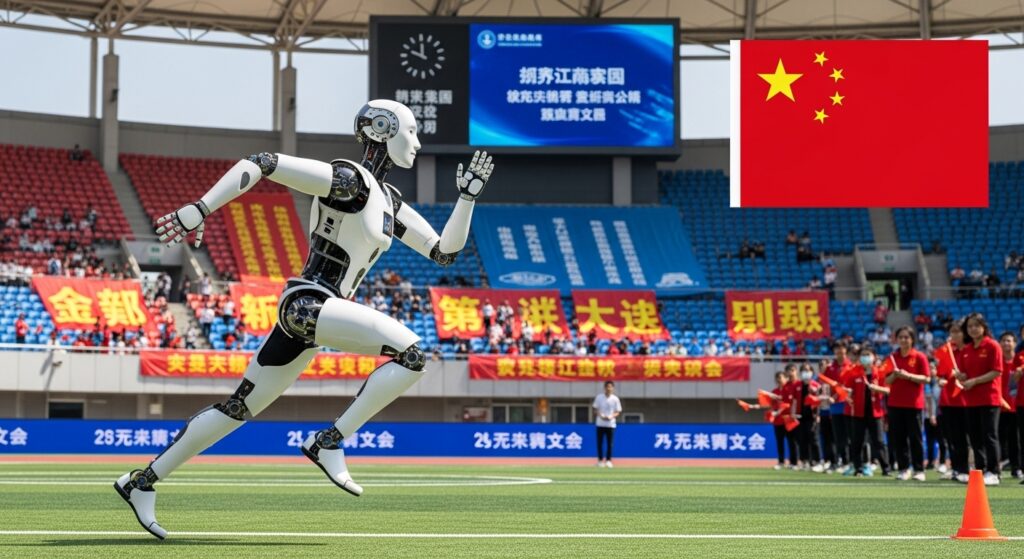
Beijing will inaugurate the World Humanoid Robot Games from August 15 to 17, running alongside the World Robot Conference (August 8–12) at major venues like the Bird’s Nest and the Ice Ribbon. Over 20 countries will participate in events including soccer, martial arts demos, and scenario-based tasks like sorting and medical assistance. (Source: Xinhua via Chinadaily, Asia Times preview)
T1 Humanoids Practice on Robot Soccer Pitch
Members of Tsinghua University’s Hephaestus team are training with the Booster Robotics T1 humanoid robot ahead of the Games. The robots recently won gold in the adult-size division at RoboCup in Brazil and are practicing soccer drills, balancing tests, and agility courses at Beijing’s National Speed Skating Oval. (Source: Reuters)
Why This Event Is a Robotics Milestone
Experts see embryonic sports events such as fully autonomous robot soccer as testing grounds for perception, real-time decision-making, obstacle avoidance, and collaboration—skills essential to more useful applications in logistics and public service robotics. (AP News and Bloomberg local coverage highlight the match’s autonomy.) (Source: AP News) That optimism should be tempered: just 7,000 humanoid robots were sold worldwide last year, a reminder of how far the industry is from scale.
Broader Context: Government-Backed Innovation
The games are part of China’s larger strategy to lead in humanoid AI, supported by government and academic institutions. Earlier this year, Beijing hosted a humanoid robot marathon and half-marathon events to train endurance and test control systems. The initiative demonstrates how competitive robotics can accelerate real-world system development and public trust. Beijing is turning robotics into public spectacle more broadly, including the world’s first ‘4S’ robot mall. (Source: Chinadaily relay event, Robotics & Automation News)