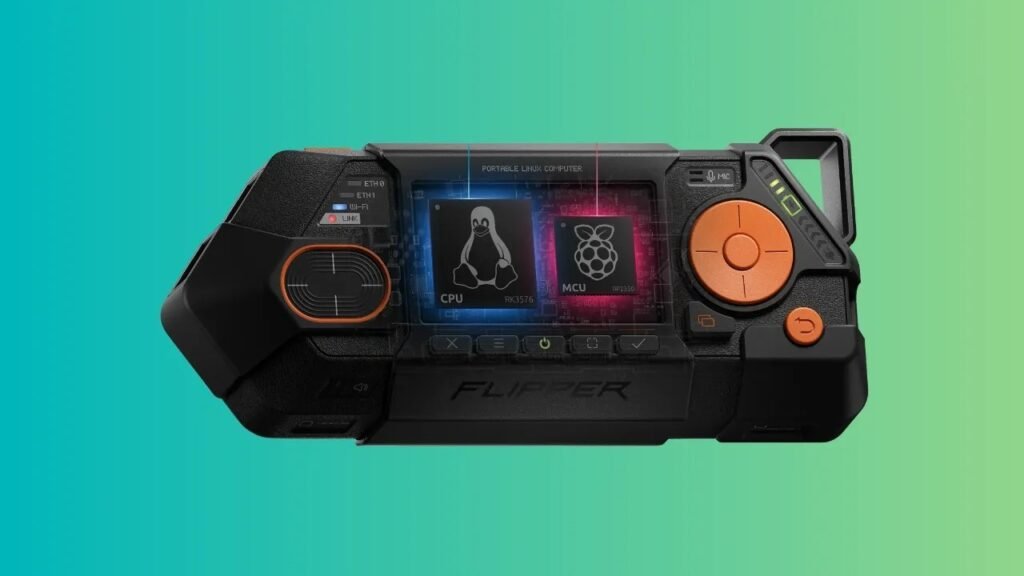
The Flipper One was supposed to be a niche gadget for network engineers. Instead it has become the fastest-funded hardware launch of the year. Flipper Devices opened its Kickstarter campaign on November 17, asking for a few hundred thousand dollars to fund the first production run of a $399 pocket Linux computer. Within about 12 hours it had raised nearly $10 million. Within 24 hours, $11.7 million. By November 21 the total stood at $15.5 million from more than 28,500 backers — more than 40 times its goal.
The device is deliberately unlike its famous predecessor. The Flipper Zero, which raised $4.8 million on Kickstarter in 2020 and has since sold more than a million units, is a pocket tool for offline protocols — NFC, RFID, sub-GHz radio, infrared. The Flipper One drops all of that. It is, BleepingComputer reports, a portable Linux computer built for networking: an eight-core Rockchip RK3576 processor, 8GB of LPDDR5 RAM, 64GB of storage, Wi-Fi 6E, two Gigabit Ethernet ports, HDMI 2.1 and an eSIM, running a Debian-based system called Flipper OS on a mainline Linux kernel.
Five Networks at Once, in Your Pocket
The hardware is built around a simple idea: one box that can sit between you and any network. It manages up to five uplinks at once, with failover, load balancing, firewall rules and VPN tunnels, and it can act as a hotspot, a travel router, an inline Ethernet sniffer or a desktop computer when plugged into a monitor over USB-C. A second processor, a Raspberry Pi RP2350, runs the small monochrome display and the buttons, so the device stays controllable even when Linux is rebooting. Expansion comes through an M.2 slot: a LoRa module for off-grid mesh messaging ($59), a software-defined radio module ($149) and a 5G modem ($219).
The Price That Makes No Money
The $399 price is the strangest part of the story. RAM and storage now account for more than half of the Flipper One’s hardware cost, and the company says the price covers production and nothing more. Back in May, Flipper told XDA Developers it would try to keep the base configuration at $350 or less; the memory market had other ideas, and the price has risen by $49 since. Chief executive Pavel Zhovner has been unusually candid about the maths: the device would need to sell for “around 500 bucks” to be financially sustainable, and if it cannot sell enough units at a price that covers its costs, Flipper may cancel the Kickstarter before it ends. Early buyers who paid $20 for a pre-order coupon locked in a $379 tier — and voted the second colour, Moss, into existence.
Why This Matters
Strip away the gadget, and the Flipper One is a stress test of the memory crisis. The same shortage that pushed the Pixel 10a’s price up, added $100 to the iPhone 18 Pro and lifted the MacBook Neo from $599 to $699 is now deciding whether a small hardware company can afford to build its product at all. Flipper is selling at zero margin and betting the memory market improves before the first batch ships in July 2027. Backers are not just buying a pocket network lab — they are funding a batch that may never be repeatable at this price. If memory gets cheaper, the One becomes a cult classic. If it does not, $399 will look, in hindsight, like the cheapest this computer ever was.
Meanwhile in Gadgets: the Flowtica Verso puts live meeting transcripts on a tiny E Ink screen — and Meta’s Muse Charm is $300 — or free with Verizon 5G.