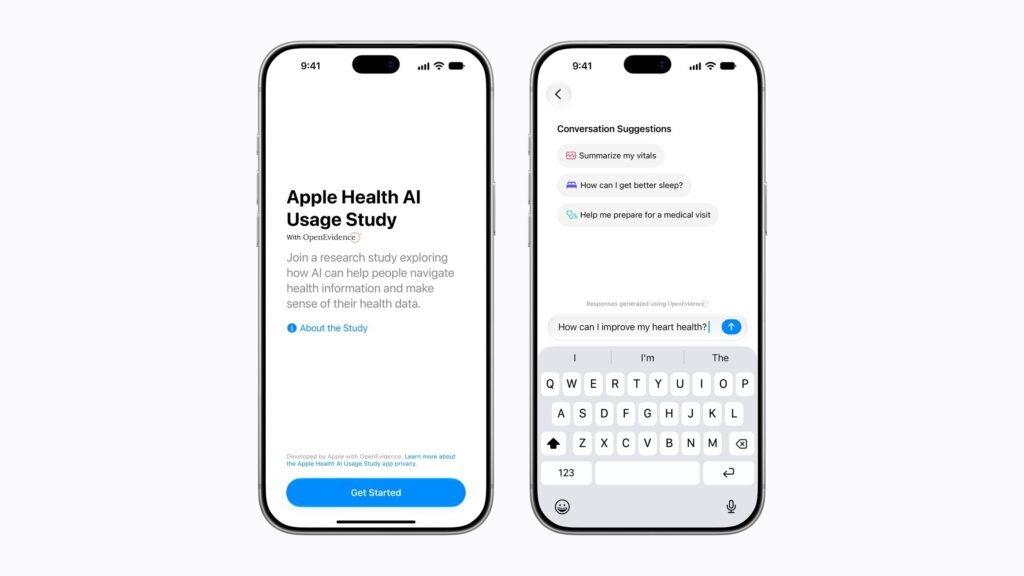
Apple wants 200,000 iPhone users to ask an AI their health questions — and then tell it when the answers are wrong. According to TechCrunch, Apple announced the Apple Health AI Usage Study on 15 November, a year-long research project built with clinical AI company OpenEvidence and delivered through a standalone iOS app available to download now.
The study aims to enrol up to 200,000 participants and run for more than 12 months. Participants ask everyday health questions in the app and receive simplified answers grounded in clinical data from sources including The New England Journal of Medicine, the Journal of the American Medical Association and Nature, with linked peer-reviewed citations. They then rate the answers for accuracy, detail and relevance, and take monthly surveys.
Here is the part that matters most: Apple is deliberately not shipping this. The study app is not integrated with Siri or Apple Intelligence. It is a research app, separate from everything on your iPhone — a year-long trust experiment before Apple ever puts an AI health answer in your pocket.
Study first, ship later — if ever
The contrast with the rest of the industry is stark. Earlier in 2026, OpenAI said users were asking more than 300 million health-related queries a week on ChatGPT — with no clinical grounding at all. Apple is taking the opposite approach: study the behaviour, measure the trust, and only then decide whether the feature deserves to exist.
“At Apple, we believe responsible innovation starts with scientific rigor and clinical grounding,” said Sumbul Desai, MD, Apple’s vice president of Health and Fitness. “Health is deeply personal, and conducting a dedicated research study is the most thoughtful way to understand how people engage with, comprehend, and evaluate health AI in everyday life.”
Apple has not said whether any of this ever becomes a consumer feature in the Health app or Siri. That silence is the point: the study is designed to answer the question first.
Most iPhone owners are locked out
Eligibility is narrow. Apple’s Newsroom states participants must be US residents aged 21 or older with an Apple Intelligence-enabled iPhone — iPhone 15 Pro or later — running iOS 26 or later. That rules out most of the iPhone installed base, including every standard iPhone 15 and anything older.
Those who do qualify can optionally share HealthKit data — resting heart rate, activity, sleep and lab results — for more personalised answers. The app also has safety guardrails intended to detect certain concerning questions and suggest following up with a healthcare provider. It is not meant to diagnose or treat any condition, or to replace professional medical advice.
A new privacy baseline for health AI
The privacy terms are unusually strict for a consumer AI product, and they may be the study’s most lasting contribution. TechCrunch reports participant data is anonymised before being sent to a secure third-party cloud provider and will not be used to train AI models. OpenEvidence deletes query and response data after 24 hours — a bar the rest of the health AI market does not currently meet.
Why this matters
The launch coverage all reports the same facts: 200,000 participants, OpenEvidence, clinical sources. What it misses is the strategy. Apple is the only major AI company choosing to study health answers for a year before selling them — while its rivals field hundreds of millions of ungrounded health queries a week and treat the answers as a feature, not a research question.
That caution is also a competitive weapon. If the study finds people trust clinically grounded answers and reject the rest, Apple will have the evidence — and the privacy architecture — to ship a health AI its rivals cannot match without rebuilding theirs. If it finds people cannot tell good answers from bad ones, Apple will have learned that before a bad answer ever reached a billion pockets. Either way, the year of studying comes before the shipping. That is the story.
Meanwhile in Apps & Tools: Apple’s warning about AI data access shows the same privacy-first instinct behind this study
Meanwhile in Apps & Tools: ChatGPT’s locked chats and privacy fine print — what happens to your health questions there