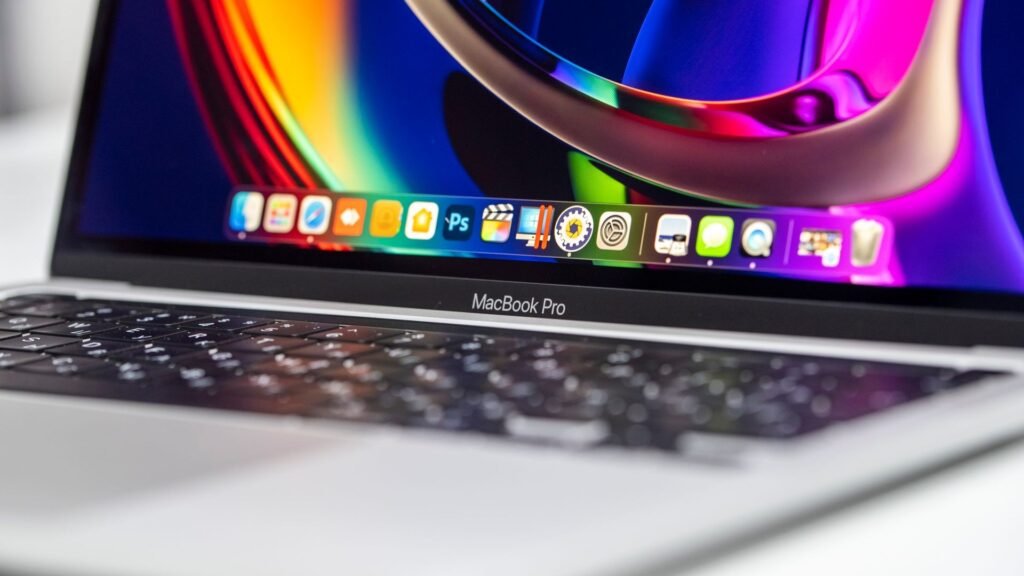
Apple has finally made a touchscreen Mac, and it has priced the privilege accordingly. The new MacBook Pro with a PROLED XDR display starts at $2,899 for the 14-inch model and $3,399 for the 16-inch model — and if you tick every upgrade box, the bill climbs to $14,549. The touchscreen is the headline. The price ladder is the story.
According to TechCrunch, Apple launched the touchscreen MacBook Pro on October 28, nearly a decade after it first experimented with touch on a laptop through the Touch Bar, which it later removed. The new machine uses M5 Pro and M5 Max chips, offers up to 128GB of unified memory and up to 16TB of storage, and replaces the camera notch with a Dynamic Island-style cutout.
The Price Ladder, Rung by Rung
TechCrunch reports that the fully loaded 14-inch model costs $14,249 and the 16-inch version costs $14,549, both with Apple’s top-tier M5 Max chip, an 18-core CPU, and a 40-core GPU. The M5 Max versions start lower, at $4,499 for the 14-inch and $4,799 for the 16-inch, before a single storage or memory upgrade.
The upgrades add up fast, and that is where the memory shortage bites. Moving to a 4TB SSD costs an additional $1,000, while upgrading to 8TB adds $3,000. The new 16TB option adds $7,000 on its own. Another $2,000 buys 128GB of memory, while nano-texture glass adds $150. For comparison, the previous 16-inch MacBook Pro topped out at $10,149 — the new ceiling is $4,400 higher.
What the Touchscreen Premium Actually Buys
The display itself is the upgrade, not the processor. The PROLED XDR panel is a tandem OLED display with 2,000 nits of peak HDR and SDR brightness and a 10,000,000:1 contrast ratio. Apple built the touch sensor directly into the panel rather than layering it on top, which it says reduces latency, and it redesigned the hinge to keep the screen stable when touched and to steady the camera on video calls.
Crucially, these touchscreen models do not use Apple’s newest chip. They run M5 Pro and M5 Max, while the standard 14-inch MacBook Pro unveiled the day before uses the newer M6 chip and starts at $1,999 with the existing mini-LED display and no touchscreen. That trade-off, not the $14,549 ceiling, is the decision most shoppers will actually face.
It also carries three Thunderbolt 5 ports, HDMI, an SDXC slot, MagSafe, and a headphone jack, and weighs 3.0 pounds (14-inch) or 4.0 pounds (16-inch).
Why Apple Finally Said Yes to Touch
Apple executives spent years scoffing at the idea. Steve Jobs famously called a touchscreen Mac ergonomically terrible. What changed is partly engineering — a sensor built into the panel, a stiffer hinge, and macOS translating touches into clicks — and partly the audience: younger creators expect to tap, pinch, and drag.
Preorders open October 30, with availability beginning November 6. That gives reviewers barely a week to answer the question Apple has left open: does touch on macOS feel essential, or does it feel like an expensive novelty on a machine most people will still use with a keyboard and trackpad?
Why this matters
The commodity coverage stops at the $14,549 shock figure. The useful story is the ladder underneath it. Many buyers will talk themselves one rung up, and each rung is priced while memory is scarce and AI demand is bidding it up.
That makes the buying decision unusually clear. If you edit video, grade color, or draw on screen all day, the OLED touch panel may justify the premium over the $1,999 M6 model. If you mostly write, browse, and run office apps, the M6 MacBook Pro gives you a newer chip for $900 less than the cheapest touchscreen model. At $14,549, you are no longer buying a laptop; you are buying a workstation that happens to fold.
Meanwhile in Gadgets: our breakdown of Apple’s M6 MacBook Pro and iMac prices and specs covers the cheaper, newer-chip alternative announced the day before, and our look at the OLED iPad Mini price hike shows Apple is pushing OLED — and higher prices — across its lineup, not just on the Mac.