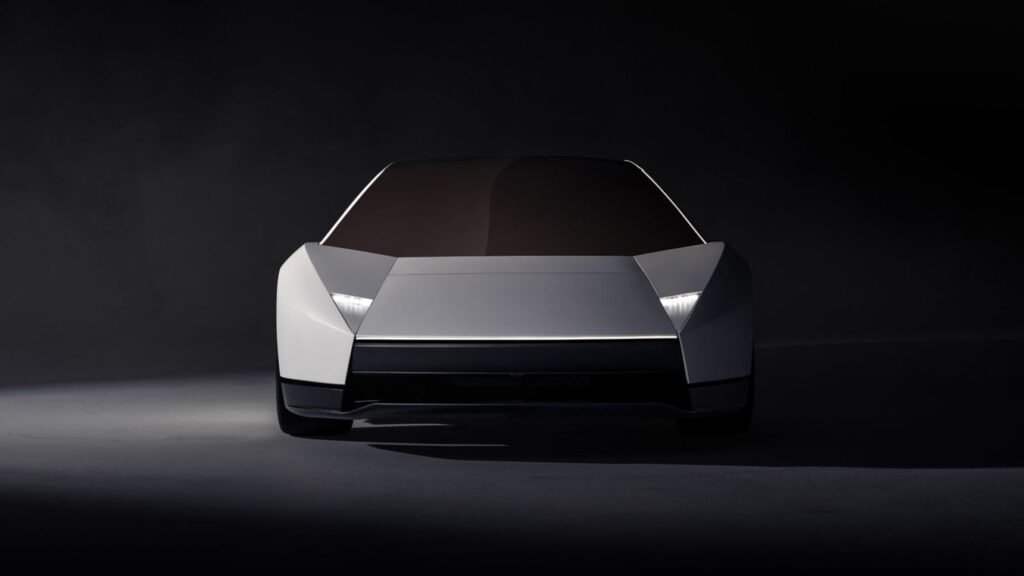
Nine years after Tesla promised a second-generation Roadster, and six years after its original delivery date sailed past, the car finally did something nobody could look away from. On October 15, at a SpaceX rocket test site in McGregor, Texas, the new Roadster drove upside down along a ramp, flipped through the air with cold-gas thrusters, and landed on its wheels — with nobody inside.
The demonstration was pure spectacle, but the fine print matters more than the stunts. According to Electrek, Tesla used the event to reveal not one car but three configurations — and reopened reservations without announcing a price for any of them.
Three Roadsters, Not One
The lineup Tesla posted after the livestream breaks down like this: the two-seat Performance is the road-ready version, with active aerodynamics and a fan-based suction system Tesla says can hold the car upside down even when stationary, and a claimed 0–60 mph time under 1.6 seconds. The Thrust adds rear-mounted cold-gas thrusters for a claimed sub-0.9-second sprint, in limited release. The Rocket gets thrusters around the entire perimeter — a “full flight system” — in a single-seat, invite-only car Tesla admits is not approved for public roads.
Reserving one costs real money today: $5,000 due immediately, which Tesla calls fully refundable, plus another $45,000 within 10 days or the reservation is canceled. That’s the same $50,000 Tesla asked for back in 2017. The Thrust requires a $250,000 deposit, USA Today reports. The final price of any version? Tesla didn’t say.
The Numbers Nobody Independently Timed
The headline figure from the night was a 0–60 mph run in a claimed 0.81 seconds. But no independent timing was shown — it was Tesla’s own number from its own stage. The claimed top speed is over 230 mph on the Rocket, and range is quoted at over 300 miles. That last figure is worth pausing on: the 2017 prototype promised 620 miles and seating for four. The 2026 car promises half the range and two seats at most. As Electrek noted, Tesla collected $50,000 to $250,000 deposits from 2017 reservation holders on the strength of specs that have since been rewritten.
The thrusters themselves are genuinely novel engineering: compressed air stored in carbon-fiber overwrapped pressure vessels packed into every usable void of the car, generating four to five times the force the tires can handle — which is how the car sidesteps the traction limit that caps every other car’s acceleration. Track Mode lowers the body and deploys wings driven by actuators developed for Tesla’s Optimus robot, with claimed downforce “approaching F1 levels.”
Why This Matters
Here’s what the stunt coverage mostly skipped: the Roadster’s aerial tricks are happening on the one trim you cannot buy and cannot legally drive. The Rocket is invite-only and unapproved for public roads, and USA Today notes that “the use and legality of such features on public roads were not immediately clear.” Musk himself told the crowd he wasn’t sure it was legal everywhere, and the demo car ran without a driver “to make sure we don’t kill anyone,” as he put it — while also calling the Roadster “not necessarily a safety optimized car.”
Meanwhile Tesla wants $50,000 to $250,000 in deposits for a car with no announced price and a production target of “2028, actually” — an actual quote from Musk. Tesla sold 1.6 million vehicles last year; one analyst expects roughly 2,000 Roadsters a year. Musk has called the car a “small potato situation” that won’t move the needle financially, even as it becomes, in Morningstar’s words, the company’s new halo car.
So the Roadster that flipped over Texas isn’t really a product launch. It’s a $250,000-per-seat advertisement for Tesla’s engineering, aimed at buyers who will fund the stunts. The only Roadster most people could ever drive — the Performance — does none of the flying. It just goes very fast, for a price Tesla still won’t name.
Meanwhile in Cars & EVs: Tesla’s mainstream business had its own strange week — Model 3 orders in Canada were abruptly paused over a quota mystery — while global EV sales data for September showed the broader market cooling.