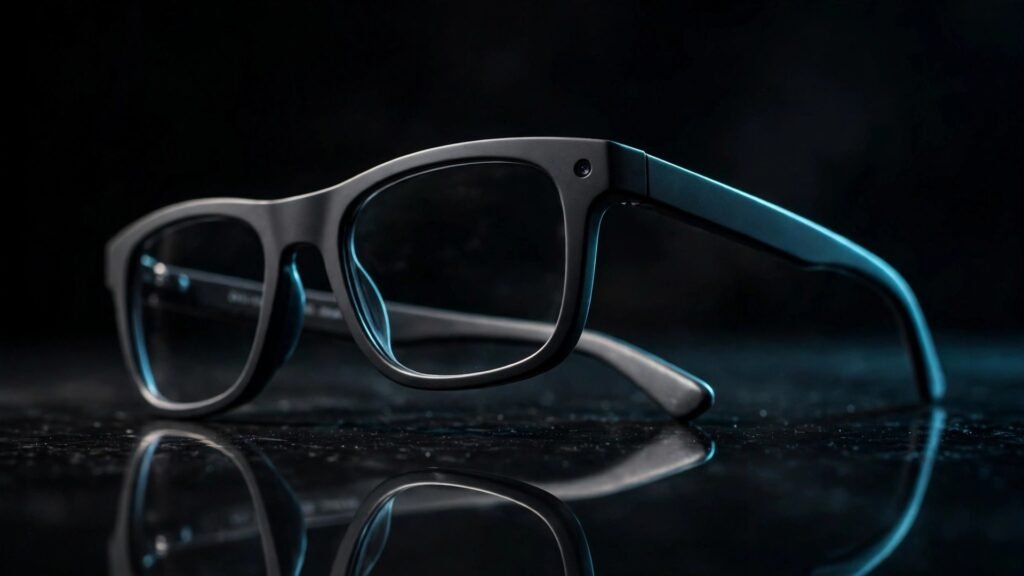
Alibaba just went to war with Meta — over your face. At a Hangzhou event on October 13, the Chinese tech giant put its Qwen Glasses N1 series on sale: AI smart glasses with a 50MP camera, swappable batteries, and a Pro model with eye tracking and iris payments, starting at 2,999 yuan (about $450). Bloomberg reports the launch also includes Qwen Clip, AI earbuds co-engineered with Bose. The catch for American readers: you cannot buy any of it.
The glasses are on sale in China through Taobao, Tmall, JD.com, and Douyin, after a preview at September’s Apsara Conference. Launch-platform discounts push the street price lower — around 2,218 yuan on some retail platforms — but the pre-discount figures are the honest comparison point.
The Hardware: What $450 Buys
The spec sheet is aggressive. The N1 shoots 4K video through its 50MP camera, uses bone-conduction microphones, and talks to Alibaba’s Qwen AI by voice. Battery life is rated at 25 hours standby or 9 hours of music — and the 272mAh batteries are hot-swappable, meaning you can change them without powering down. An optional MiniBag adds 700mAh more.
The N1 Pro (3,499 yuan) goes further: eye tracking for visual interaction and object recognition, iris verification for Alipay payments, and health monitoring covering heart rate, blood oxygen, skin temperature, heart-rate variability, and stress. The Qwen Clip earbuds (1,299 yuan, roughly $195) bring an open-ear clip-on design with Bose audio and a headline feature: translation across 89 languages, plus transcription and background task handling. TechNode notes the whole line runs on Qualcomm’s Snapdragon AR1 platform.
The Showdown With Meta
Bloomberg frames Meta’s Ray-Ban smart glasses as the benchmark — and on hardware, Alibaba just leapfrogged them. Swappable batteries alone solve the biggest complaint about every smart-glasses generation so far. Eye tracking and iris payments are features Meta’s lineup does not offer at any price.
Meta’s answer, notably, went the other direction: last month it launched a simplified, camera-free model at $349 built around its Muse AI assistant — cheaper, but conceding the camera arms race entirely. One company is racing toward more sensors; the other is racing toward fewer. Alibaba CEO Eddie Wu calls the strategy “all-stack AI”: models, chips, cloud, and now consumer hardware, with glasses as the entry point for Qwen’s agents.
A short privacy footnote is warranted: the Pro is a camera-first device that records the world around its wearer, which raises the consent questions every camera-glasses generation has faced. Alibaba has not detailed indicator-light or consent UX beyond the hardware specs.
Why this matters
The strangest thing about this launch is the geography. The most interesting AI-eyewear battle on earth is happening in a market American buyers cannot shop. US buyers get Meta’s $349 camera-free Muse glasses; Chinese buyers get 4K cameras, eye tracking, and iris payments for $450.
That asymmetry will not hold forever. Either Alibaba takes Qwen hardware global, or Meta and its rivals are forced to match the spec sheet. Until then, the N1 is a window into where the category is going — whether or not you can buy the window.
Meanwhile in Gadgets: Apple’s $299 HomeView and its hidden costs — another launch where the sticker price is just the start.
Meanwhile in Gadgets: the Surface Laptop Ultra’s fine print — spec-sheet claims, decoded.