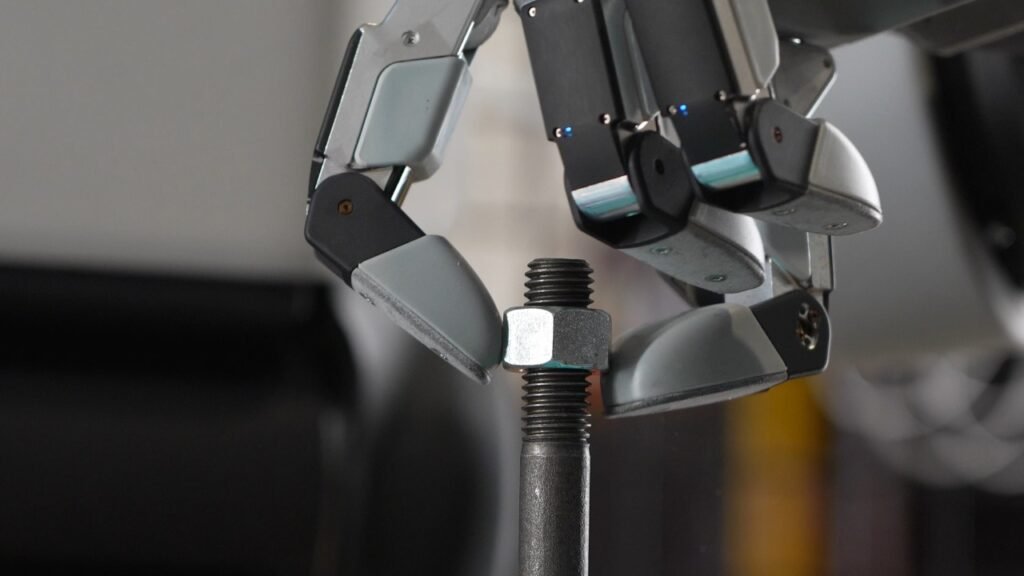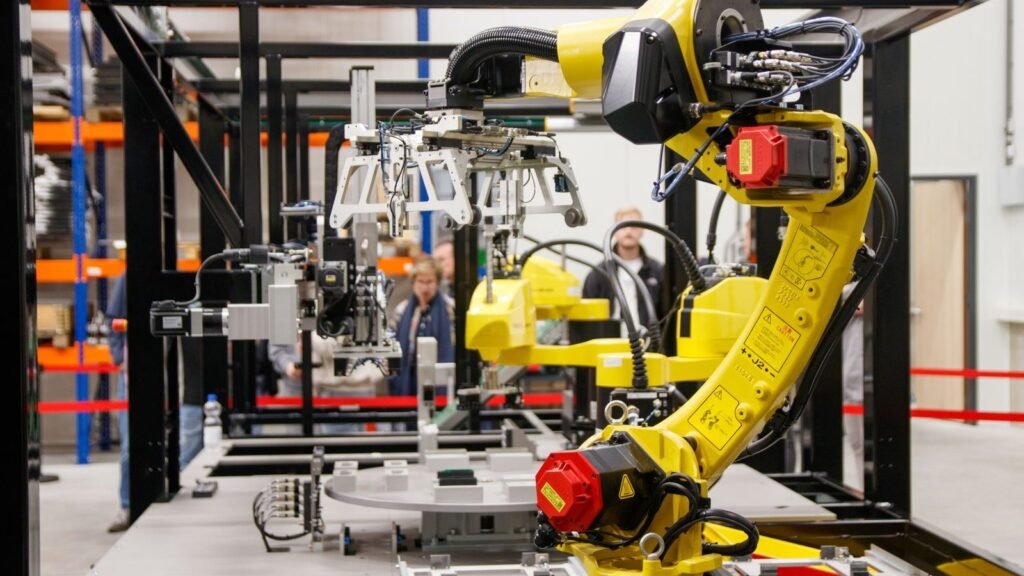
“Physical AI” is the phrase of the year in robotics — and most of the time it means a demo video and a press release. Productive Robotics’ new OB7-AI, unveiled at IMTS 2026 in Chicago, is one of the rare cases where the phrase describes something concrete: a 7-axis collaborative robot that scans your CNC cell, finds its own way around the machine, and literally reads the CNC screen to know when a cycle is done, RoboticsTomorrow reports.
What the AI actually does
Strip away the branding and OB7-AI performs a closed loop that older cobots never closed. It automatically scans the machine’s work area to learn where everything is, so operators no longer have to precisely place blanks on the work table — as long as there is “finger room” between each blank, the gripper finds them.
Then it does the job: opens the machine door, loads the part in the vise, closes the door, and pushes the start button. And here is the detail that matters — to determine when a machining cycle is finished, OB7-AI reads the CNC screen itself. It does not trust a timer. It watches for the machine’s own signal, then opens the door, unloads the finished part, and repeats until the job is complete.
According to Productive Robotics president Zac Bogart, there are no AI training cycles required for new parts or tasks. That is a meaningful claim: the “AI” here is perception and adaptation at runtime, not a model you have to feed with your own data before it becomes useful.
The teach-by-touch lineage
OB7-AI builds on the company’s decade-old formula: zero programming, teach-by-touch. An operator physically guides the arm through a job once, using drag-and-drop tiles on a tablet, and the cobot remembers it. The new part is that the operator no longer has to be precise about it — the robot handles the imprecision itself.
The 7th axis matters here too. Unlike conventional 6-axis arms, the OB7’s extra joint mimics the dexterity of a human arm, so it can sit to the side or back of a CNC machine and still reach around the sliding door. The front door can stay open, giving operators access for setups, tool changes, and inspections without moving the robot.
Why machine tending is the beachhead
CNC machine tending is the perfect first battlefield for this kind of autonomy, and the economics explain why: American job shops and contract manufacturers face acute labor shortages, rising costs, and reshoring pressure — and machine tending is repetitive, mind-numbing work that humans hate and robots do tirelessly, Industrial Machinery Digest notes.
A cobot that can run a machine overnight and on weekends, handle jobs as small as five to ten parts, and be retaught in minutes is not replacing a machinist — it is multiplying one. The operator who used to stand at the machine loading parts can now supervise three of them.
Why this matters: a closed loop, not a demo
Most physical-AI announcements this year have been vibes: a humanoid walking across a stage, a promise of “general-purpose manipulation.” OB7-AI is interesting for the opposite reason — it is narrow, verifiable, and closed-loop. Perception (scan the cell), action (load the part), verification (read the screen): the robot checks its own work instead of assuming success.
That screen-reading detail is the tell. Anyone can build a robot that pushes a start button on a schedule. Building one that watches the machine’s display and only acts when the cycle is genuinely complete is a small thing that eliminates a whole category of expensive mistakes — crashed tools, scrapped parts, machines sitting idle because a timer was wrong.
The honest caveat: this is still a product announcement from a trade show, and independent verification of the “no training cycles” claim will have to wait for customer deployments. But if OB7-AI does what Productive Robotics says it does, the most important AI in manufacturing this year is not a humanoid — it is a cobot that learned to read.
Meanwhile in Robotics: Boston Dynamics gave Atlas a four-fingered hand built for factory work.
Meanwhile in Robotics: Destro AI’s $8M bet on warehouse robots.